Monday, March 17, 2014

A FEW GOOD FINANCE BOOKS

The Widow's Handbook by Charlotte Foehner


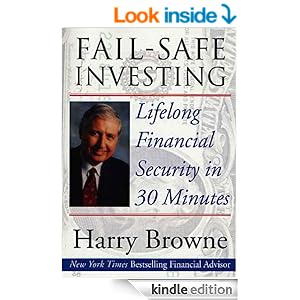
Failsafe Investing by Harry Browne


The Permanent Portfolio by Craig Rowland and J.S. Lawon

Thursday, March 13, 2014

SIMON BLACK ON FIAT PRICE CONTROLS 
Belize City, Belize

Nearly four thousand years ago, King Hammurabi of Babylon laid out his eponymous “Hammurabi’s Code”, a series of laws that is still famous to this day.


Most people know Hammurabi’s Code as “an eye for an eye, a tooth for a tooth”. Yet what few realize is that the code was actually one of the original attempts at government wage and price controls.


Hammurabi’s Code decreed, for example, that the daily rate of pay for a tailor would be five grains of silver, and a farm laborer would be six grains of silver. The cost of hiring a small animal for field work would be four bushels of corn. Etc.


Of course, Hammurabi’s attempts to control prices didn’t work one bit. In his book The Old Babylonian Merchant: His Business and Social Position (published 1950), historian W.F. Leemans writes:


“Prominent and wealthy tamkaru [merchant traders] were no longer found in Hammurabi’s reign. Moreover, only a few tamkaru are known from Hammurabi’s time and afterwards . . .”


Despite the economic failures of Hammurabi’s experiment, though, wage and price controls have been tried again and again throughout history.

2,000 years later, Emperor Diocletian of the failing Roman Empire issued his Edict on Wages and Prices. The ancient Athenians tried (and failed) to set grain prices, and even had a small army of regulators to oversee the price controls. So did the the Zhou dynasty in ancient China.


Today you can see various forms of wage and price controls all over the world– from the blatant (Argentina) to the subtle.


Major farm subsidies in the United States, for example, are a form of price controls. Monetary policy (especially keeping interest rates at effectively zero) are a form of price controls.


Yet today President Obama is set to launch another far more obvious form.

The central planner-in-chief is going to sign an Executive Order to require employers to expand overtime pay in the Land of the Free. This, on top of his recent proposal to increase the minimum wage 39% to $10.10 per hour (not that there’s any inflation).

Obviously this ‘decree by executive order’ strategy shows the political system for what it is: there is no republic, there are no checks and balances, there is no adherence to the Constitution.

They do whatever they want, however they want, with total immunity.

The troubling part about this executive order (aside from being yet another soon-to-fail wage control) is that it essentially abrogates millions of work contracts across the country.

Employers and their workers have long since agreed to terms of employment that may or may not include overtime pay.

Today President is unilaterally voiding any specific provisions about overtime pay in existing employment contracts, all in his sole discretion, and all without Congressional oversight.


The rule of law means nothing.


And even though any high school economics student can tell you that wage and price controls don’t work, the government is pressing ahead with vigor, damn the consequences.


Given their continued destruction of the middle class, perhaps it’s time we bring back ‘an eye for an eye, a tooth for a tooth.’

Thursday, February 6, 2014

BLS Employment Chart

Considering a move to another state or across the country?  Be sure to count the cost of that move by checking the employment numbers that can tell you the economic health of the city.  Open up this Bureau of Labor Statistics link and check out the interactive charts that can give you an overview of the city that you're planning on christening as your new home.

Also, if you're concerned about the financial health of a particular city across the country and whether it is solvent or not, this chart gives you a guide.


Wednesday, February 5, 2014

G. Edward Griffin on J.P. Morgan's Corner on Gold Derivatives

It’s official: JP Morgan has cornered the gold-derivatives market in the US.

To corner a market means to control a sufficient percentage of the total to be the biggest player in the field and, thereby, be able to determine prices and policies. JPM owns 60% of US gold derivatives valued at $65.4 billion.

However, those contracts are backed by only $1 billion in physical gold. That means the bank would be wiped out if gold speculators decide they want real gold instead of paper contracts for gold. If or when that happens, the physical-gold market will skyrocket, and governments likely will come to the aid of the banks by halting trading “to protect the world economy” of course. What would happen then is anyone’s guess. These are interesting times.

http://www.zerohedge.com/news/2014-02-01/market-cornered-jpmorgan-owns-over-60-notional-all-gold-derivatives

Thursday, January 30, 2014

Compound Interest


The incentive for banks to offer compound interest is exchange for large amounts of deposits. 

According to this article, Citi Bank offers compound interest on two different types of accounts. "They offer two different kinds of compound interest savings accounts. The first kind of savings account they offer is a Preferred Account. This account requires a minimum daily balance of $25,000. With this account, one percent interest is compounded daily. The second account that they offer is a Starter Account. This account only requires a $100 daily balance. If you have this account, they compound interest monthly at 0.90 percent."


Credit card companies, mortgage banks, and others charge you compound interest.  So as certain institutions charge you compound interest, why not try and earn compound interest for yourself?


Tuesday, January 21, 2014

Metal Content of US Coins Gets Expensive

Robert Wenzel of Economic Policy Journal reviews WSJ article on mintage . . .

Price Inflation Will Force the US Mint to Once Again Change the Metal Content of Coins

Price inflation indexes may not indicate much 
inflation, but the US Mint knows that the indexes 
don't reflect the true picture .

The  Mint is considering a change to the mix of
metals it uses to make quarters, dimes and 
nickels, because of the climbing cost of 
production of the coins. reports WSJ.

It now costs 1.8 cents to make a penny and 
9.4 cents to make a nickel, costing the 
federal government about $104.5 million 
last year.

If the materials are altered for the first time 
in half a century or more, some coins could 
have new colors and weigh less, says WSJ.
It plans to keep the diameter and thickness 
of any potential new coins the same as 
existing specie.

Richard Peterson, the top official at the Mint,
said completely stopping production of the 
penny is a "discussion topic."

"[D]imes and quarters, they are really the 
workhorses of the coin lineup right now," 
Peterson said.

I fully expect that in the next bout of 
accelerating price inflation that the value 
of the metal content of current nickels will 
soar. Thus, nickels are a great no downside 
investment. If the price inflation I anticipate 
doesn't develop, just spend the nickels. For 
more on nickels as an investment see:
Why You Need to Own Nickels, Right Now

Sunday, January 19, 2014

Chinese Shadow Banks on Verge of Default?

from Bob Wenzel . . . 

SUNDAY, JANUARY 19, 2014

Breaking: Chinese Financial Firm Warns Shadow Bank May Not Repay Its Debt
Reuters reports:
"The trust firm responsible for a troubled high-yield investment 
product sold through China's largest banks has warned investors 
they may not be repaid when the 3 billion-yuan ($496 million)
product matures on Jan. 31, state media reported on Friday.

Investors are closely watching the case to see if it will shatter 
assumptions that the government and state-owned banks will 
always protect investors from losses on risky off-balance-sheet 
investment products sold through a murky shadow banking system.

Based on a loan to an unlisted coal company, the now distressed 
product was created by China Credit Trust Co Ltd, while Industrial 
and Commercial Bank of China , the world's largest bank by assets, 
helped to market it to wealthy investors in central Shanxi province.

On Friday, the official China Securities Journal reported that the 
trust company is considering legal action to press related parties 
for repayment to protect investors' interests.

The newspaper went on to quote trust industry sources saying an 
outright default was likely to be avoided simply by delaying 
repayment until arrangements were made to repay investors by 
other means."

I have been reporting at the EPJ Daily Alert that China is on the
verge of a huge collapse. Indeed, in recent weeks I have been
advising that Chinese financial sector ETFs be shorted.

China may be able to bail out one deal, but the problem is developing
nationwide across the capital goods sector, and a nationwide bailout
would mean massive inflation. Eventually, China is going to have to
either allow a massive crash or print incredible amounts of money
that risks major unrest from the general public who will have to deal
with the price inflation consequences.